If job growth slows when immigration slows, what does that say about the story politicians have been telling for years? Justin Wolfers uses plain-English economics to answer that question—and to show why the immigration debate affects far more than border politics.
At the center of this discussion is a basic but often ignored fact: people are more than workers. They are also consumers, neighbors, entrepreneurs, and sources of new ideas. When immigrants arrive, they do not just increase labor supply. They also increase demand for homes, food, transportation, healthcare, education, and countless local services. That helps support jobs throughout the economy.
Justin Wolfers argues that the familiar “they’re taking your job” message depends on a false assumption that there is a fixed number of jobs to go around. Economists call this the lump of labor fallacy. It sounds intuitive, but it misses how growth actually happens. More people can mean more production, more spending, more innovation, and more employment.
The video then turns to an important political reversal. Trump administration figures defending weaker payroll numbers have said the economy no longer needs as many new jobs because immigration has fallen. That claim is revealing. It concedes that immigrants were helping generate jobs all along.
Using research on the sharp drop in net migration and a simple back-of-the-envelope calculation, Justin Wolfers shows how the decline in working-age immigration roughly matches the decline in monthly job growth. The implication is that restricting immigration may shrink the economy’s capacity to create work.
That matters to you because a slower-growing economy usually means fewer openings, weaker local business activity, and less opportunity for workers and families trying to get ahead.
Topics covered:
Why the immigration debate is really about how economies grow
How the lump of labor fallacy distorts public policy
Why immigrants are both workers and consumers
How immigrants can complement native-born workers
Why business formation is part of the immigration story
What Trump advisors said about weaker job growth
How falling net migration affects labor force growth
Why fewer immigrants can mean fewer jobs overall
Contents:
00:00 The Question That Changes The Debate
01:09 The Claim That Immigrants Take Jobs
02:28 Why That Story Misses Half The Economy
03:22 The Lump Of Labor Fallacy In Plain English
04:29 Why Newcomers Expand The Pie
05:42 The White House’s Accidental Admission
06:56 The Economics Of Workers Plus Customers
08:09 What The Migration Data Shows
09:29 Simple Arithmetic, Big Implications
10:21 Why This Matters For Your Paycheck
💡 Key takeaway: Immigration is part of what makes economies more dynamic, and cutting it can reduce job creation rather than protect it.
Subscribe for more from Justin Wolfers—where the analysis is evidence-based, the jargon is optional, and the arithmetic mostly behaves. 📚
"Most obviously, the tariffs don't appear to be based on actual trade barriers, which undermines their entire justification. Contrary to White House messaging, the formula for determining the new rates turns out to have been based simply on the dollar value of goods the U.S. imports from a given country relative to how much it exports…
The result is that there is no clear or obvious path that countries could take to get those tariffs removed even if they wanted to. Countries can remove all of their trade restrictions and still run a trade surplus…"
"The main thrust of the postwar American order of globalization has involved relying more and more on cheaper labor. The trade issue and the immigration issue are two sides of the same coin," Vance told New York Times columnist Ross Douthat in an extensive interview published last month.
"The populist vision, at least as it exists in my head, is an inversion of that: applying as much upward pressure on wages," Vance said…
This economic dependence is filtering into everyday life. Chinese products are ubiquitous and over half of the million cars sold in Russia last year were made in China. Tellingly, the top six foreign car brands in Russia are now all Chinese, thanks to the exodus of once dominant Western companies. It's a similar story in the smartphone market, where China's Xiaomi and Tecno have eclipsed Apple and Samsung, and with home appliances and many other everyday items.
These shifts are tectonic. Even in czarist times, Russia shipped its commodities to Europe and relied on imports from the West of manufactured goods. Russia's oligarchs, blacklisted by most Western countries, have had to adapt to the new reality. Last month, the businessman Vladimir Potanin, whose fortune is estimated at $23.7 billion, announced that his copper and nickel empire would reorient toward China, including by moving production facilities into the country. "If we're more integrated into the Chinese economy," he said, "we'll be more protected."
"I wish people would stop calling Donald Trump a populist. He has, after all, never demonstrated any inclination to help working Americans, and his economic policies really didn't help — his 2017 tax cut, in particular, was a giveaway to the wealthy. But his behavior during the Covid-19 pandemic showed that he's as addicted to magical thinking and denial of reality as any petty strongman or dictator, which makes it all too likely that he might preside over the type of problems that result when policies are based on quack economics...
Umair Haque joins Anthony Davis for an honest discussion about the effects of the climate crisis on the world economy after the devastating wildfire in Maui. Climate change denial by Republicans and the true cost of Trumpism - on The Weekend Show.
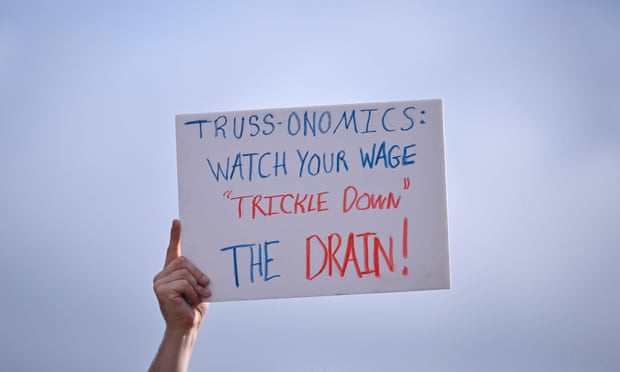
Ever since Reagan and Thatcher first tried them, trickle-down policies have exploded budget deficits and widened inequality. At best, they've temporarily increased consumer demand (the opposite of what's needed during high inflation that Britain and much of the world are experiencing).
Reagan's tax cuts and deregulation at the start of the 1980s were not responsible for America's rapid growth through the late 1980s. His exorbitant spending (mostly on national defense) fueled a temporary boom that ended in a fierce recession. The Donald Trump White House's tax cut never trickled down…
"I was amazed that they loved him so much in Texas," Mr. Bod, the former central bank governor, said. "There is no free market here." On top of that, he added, "You can't carry a gun here, but you can get a free abortion."
The two economists from the University of California, Davis's Department of Agricultural and Resource Economics found that the future of the legal cannabis business, hampered by regulation, competition and standard agricultural issues, is a bit hazy…
…the goal of the economic system Smith described is not just higher incomes on average, but mass flourishing. Raising the economy's potential should be a much higher priority for business leaders and the organizations that represent them. The Business Roundtable and the Chamber of Commerce should strongly support federally funded basic research that shifts the scientific and technological frontier and applied-research centers that spread the benefits of those advances throughout the economy. Land-grant colleges do just that, as do agricultural-extension services and defense-research applications. Promoting more such initiatives is good for business—and will generate public support for business. After World War II, American business groups understood that the Marshall Plan to rebuild Europe would benefit the United States diplomatically and commercially. They should similarly champion high-impact investment at home now…
"The most important thing is that the Dasgupta review was commissioned by the UK Treasury ministry, not the environment department. Hopefully this will mean that finance ministries around the world will acknowledge that the loss of nature is an economic issue, not simply an environmental issue."
... In April 2020, during the first wave of COVID-19, Amsterdam's city government announced it would recover from the crisis, and avoid future ones, by embracing the theory of "doughnut economics." Laid out by British economist Kate Raworth in a 2017 book, the theory argues that 20th century economic thinking is not equipped to deal with the 21st century reality of a planet teetering on the edge of climate breakdown. Instead of equating a growing GDP with a successful society, our goal should be to fit all of human life into what Raworth calls the "sweet spot" between the "social foundation," where everyone has what they need to live a good life, and the "environmental ceiling." By and large, people in rich countries are living above the environmental ceiling. Those in poorer countries often fall below the social foundation. The space in between: that's the doughnut...