Sunday, June 21, 2026
Voices of the Jim Crow South (1965) | Restored and Colorized

Sunday, May 31, 2026
Thursday, May 21, 2026
‘We will not go back to Jim Crow’: thousand of Mississippians rally for voting rights
https://www.theguardian.com/us-news/2026/may/20/mississippi-voting-rights-rally

Thursday, April 2, 2026
Saturday, February 21, 2026
History Minute (100): A literacy test to vote
See here an example of a literacy test used in 1960 in the state of Louisiana: https://www.treeoflogic.com/literacy_test.htm
And here’s what Alabama used in 1965: https://secure.splcenter.org/page/67431/survey/1?locale=en-US
How well did you do on the tests?
Friday, February 20, 2026
History Minute (099): Who or What is Jim Crow?
Many Jim Crow laws focused on segregating Blacks from Whites in schools, restaurants, rail cars, libraries, public parks, recreation centers, playgrounds, and businesses — such that they never would come into contact with one another. Others prohibited marriages or intimate relationships between White people and any non-White.
Here are some examples from a variety of states, showing the extremes states went to:
- Restaurants must provide separate rooms and separate entrances.
- Public facilities must provide separate bathrooms and drinking fountains, clearly marked for White or Black patrons.
- Separate schools must be established. Schools for Blacks must be at least a mile away from schools for Whites. If there are not enough Black students to provide a separate school, local officials were left to figure out some solution.
- Marriage between Whites and non-Whites (i.e., Black, Indian, Asian, etc.) were prohibited, and any that existed were declared void.
- Courtships of mixed races were punishable by heavy fines and jail time. Any person born to a mixed race couple was prohibited from marrying anyone. Blacks and Whites cannot live in the same home. Distribution of any printed matter in support of mixed race relationships was punishable by fine and jail time.
- Building permits for non-Whites in any area primarily inhabited by Whites was prohibited. A home or property that was “covenanted” could never be sold to non-Whites.
- Black medical students (physicians, nurses) could not take classes at public hospitals.
- Universities and colleges could only accept Black students if the state’s own college for Black students had no comparable course and the school’s governing board approved.
- Voting:
- Literacy tests: In some cases required only of Blacks; in other cases separate easier tests given to Whites than those for Blacks.
- One state law declared that no Chinese native would ever be allowed to vote. The races of all candidates were to be printed on the ballots.
- Voters must pay a tax at the polls to be allowed to cast a ballot. $1.75 was paid by a Black voter in 1945, equal to over $36 today — money that poor people could ill afford to pay.
https://en.wikipedia.org/wiki/List_of_Jim_Crow_law_examples_by_state

Sunday, February 15, 2026
History Minute (096): Civil rights enforcement blocked by the Supreme Court and President Hayes
The guarantee of civil rights promised by the Civil Rights act of 1875 was short-lived.
Numerous White business owners simply ignored the law in the South, and to a degree, also in the North. Federal enforcement efforts were weak and inconsistent. The severe economic depression of 1873 drew people’s attention, and Northern Whites tired of the many Federal government interventions in the South.
Then in 1876, the Presidential election was close and the results disputed. As a compromise to settle the election, Republican Rutherford B. Hayes agreed to remove the last Federal troops from the South in exchange for dropping challenges to his being sworn in as President. Once the troops protecting civil rights were gone, a political coalition known as the Redeemers swung into action.
(Note: You may be accustomed to thinking of Democrats as pro-civil rights and Republicans as a party with a lot of white supremacists in their ranks. However, the opposite was true in the 1870’s; I point this out lest anyone be confused while reading the below paragraphs.)
The Redeemers comprised former White Southern Democrats — Confederates, wealthy planters, merchants, and others — who aimed to “redeem” the South by overthrowing Republican state governments, which were largely backed by freed Black people, Northern “carpetbaggers” and Southern “scalawags”. They sought to restore white supremacy, limit Black civil rights, and reestablish Democratic Party dominance. They pledged a return to pre-Civil War social order. Their legal tactics included poll taxes, literacy tests, and violence through paramilitary groups like the White League and Red Shirts. By 1877, Redeemers controlled nearly all Southern governments and went about passing Jim Crow and segregation laws.
As lawsuits were filed by Black people asserting their rights when barred from main floor seating in theaters, denied seats in the ladies section of a train, or refused hotel rooms, business owners asserted that the Federal government had no right to tell them what to do. When multiple such cases made their way to the Supreme Court, and consolidated as the Civil Rights Cases, the Court struck down as unconstitutional a substantial part of the the Civil Rights Act of 1875, saying it could be applied only to state actions, not those of private businesses or individuals.
The message to business owners was that they were free to discriminate. This paved the way for Jim Crow — a comprehensive system of laws and customs that mandated segregation and subjugation of Black Americans.
Read More:
- https://uslawexplained.com/civil_rights_act_of_1875
- https://www.perplexity.ai/search/who-were-the-redeemers-in-the-lGg00EKYRGi9jYTMckpMUg
- https://www.history.com/articles/carpetbaggers-and-scalawags
- https://en.wikipedia.org/wiki/Jim_Crow_laws


Thursday, June 6, 2024
Rep. Byron Donalds says Black families were stronger during Jim Crow era - The Washington Post

Sunday, October 29, 2023
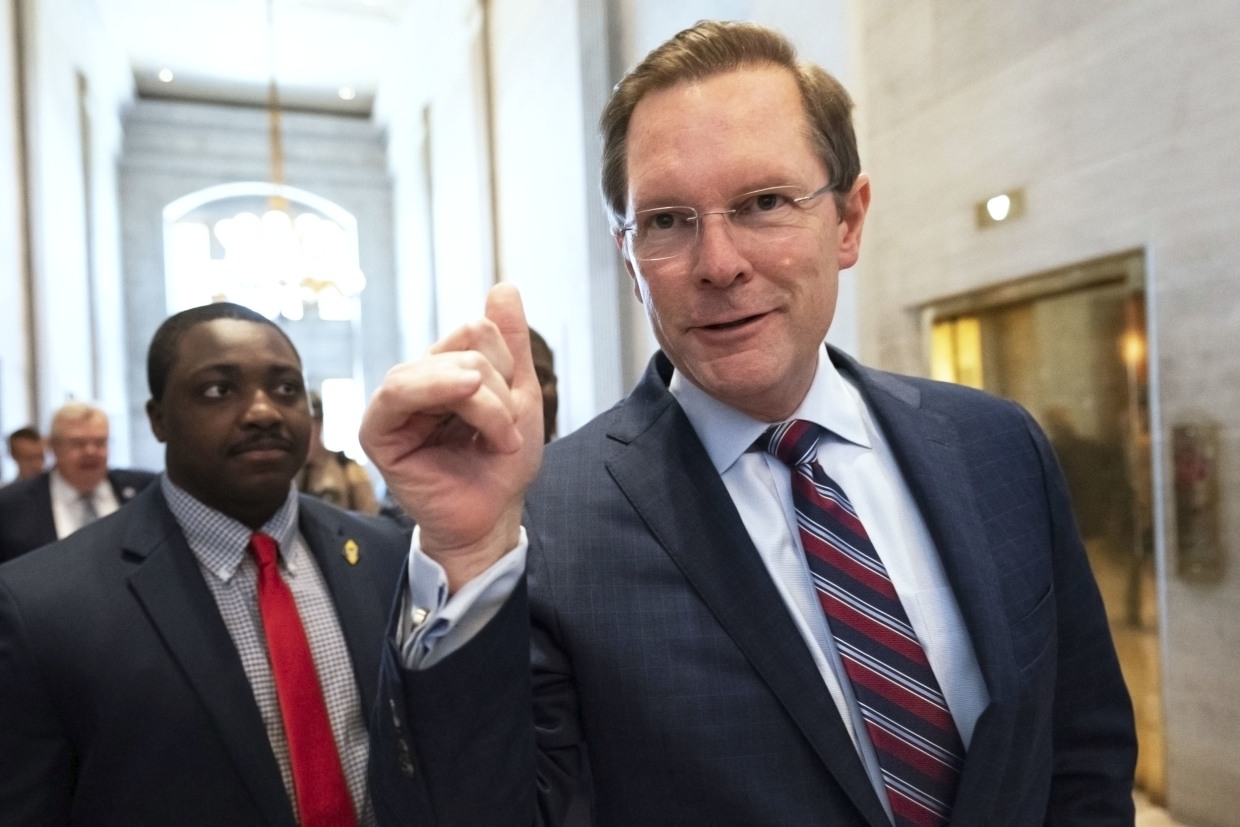
Tennessee Republicans’ federal fund fight hearkens back to Jim Crow
Saturday, November 12, 2022
'Half American' explores how Black WWII servicemen were treated better abroad (Dave Davies; Fresh Air podcast)
"There was no strategic or tactical reason to do it," Delmont says. "The only reason the military maintained this racial segregation during the war was to appease white racial prejudice."
Black servicemen traveling to the Jim Crow South for training would pull down the shades on their train cars so that white townspeople wouldn't throw rocks at the windows. Racial epithets and threats of violence were part of daily life on Southern military bases, and off base, African Americans were restricted to the "Black" sections of town.
"If they stepped even a foot outside of that, they were threatened or attacked by white police or sheriffs," Delmont says...
Interview:

Tuesday, October 11, 2022
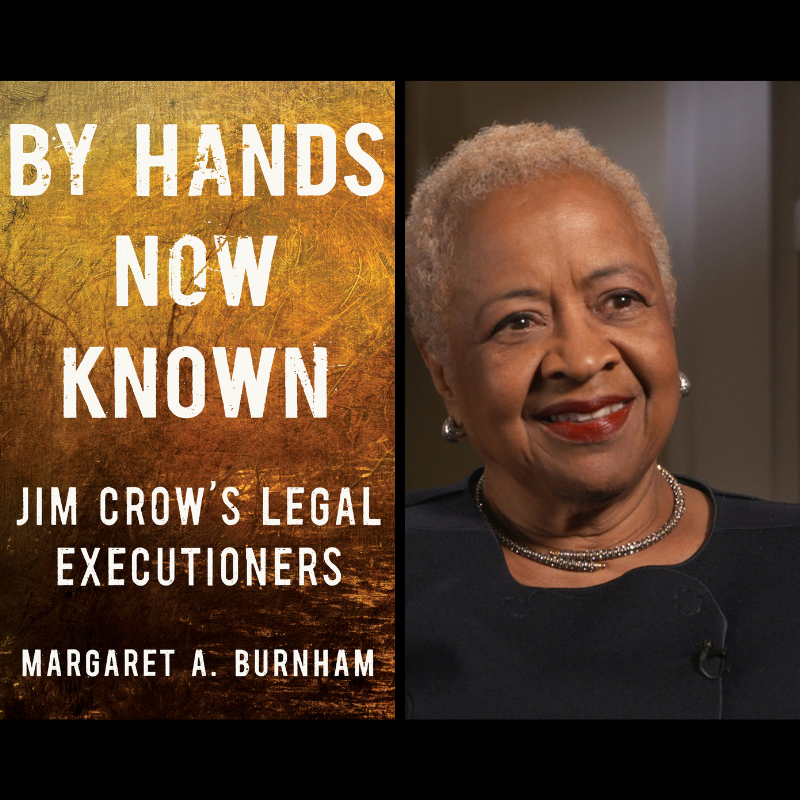
Law professor unearths cases of racial violence from the Jim Crow era (Dave Davies; Fresh Air podcast)
Tuesday, September 7, 2021
Clint Smith III on confronting the legacy of slavery (Jamil Smith; Vox Conversations podcast)

Tuesday, June 15, 2021
Rand Paul offers an accidentally useful Jim Crow analogy in rationalizing his party’s illiberal shift - The Washington Post

Monday, May 31, 2021
Republicans block ‘Jim Crow jury’ reform in Louisiana House committee

Tuesday, April 20, 2021
On the legacy of Jim Crow, Ted Cruz picks the wrong partisan fight

Tuesday, April 13, 2021
Georgia is updating Jim Crow race laws. Now, he’s Dr James Crow
Thursday, March 4, 2021
Saturday, September 5, 2020
Author Susan Neiman on Germans/Holocaust vs. America/slavery – Germans Win. (The Al Franken podcast)
Interview:
https://alfranken.com/listen/author-susan-nieman-on-germans-holocaust-vs-america-slavery-germans-win

Thursday, June 18, 2020
Monday, November 4, 2019
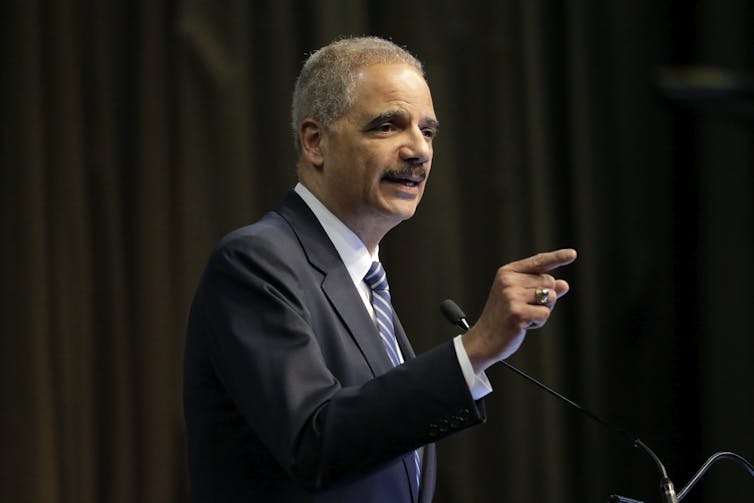
Mississippi governor's race taking place under Jim Crow-era rules after judge refuses to block them
http://theconversation.com/mississippi-governors-race-taking-place-under-jim-crow-era-rules-after-judge-refuses-to-block-them-126296

Click Older Posts above to see more.