Showing posts with label charges. Show all posts
Showing posts with label charges. Show all posts
Wednesday, June 17, 2026
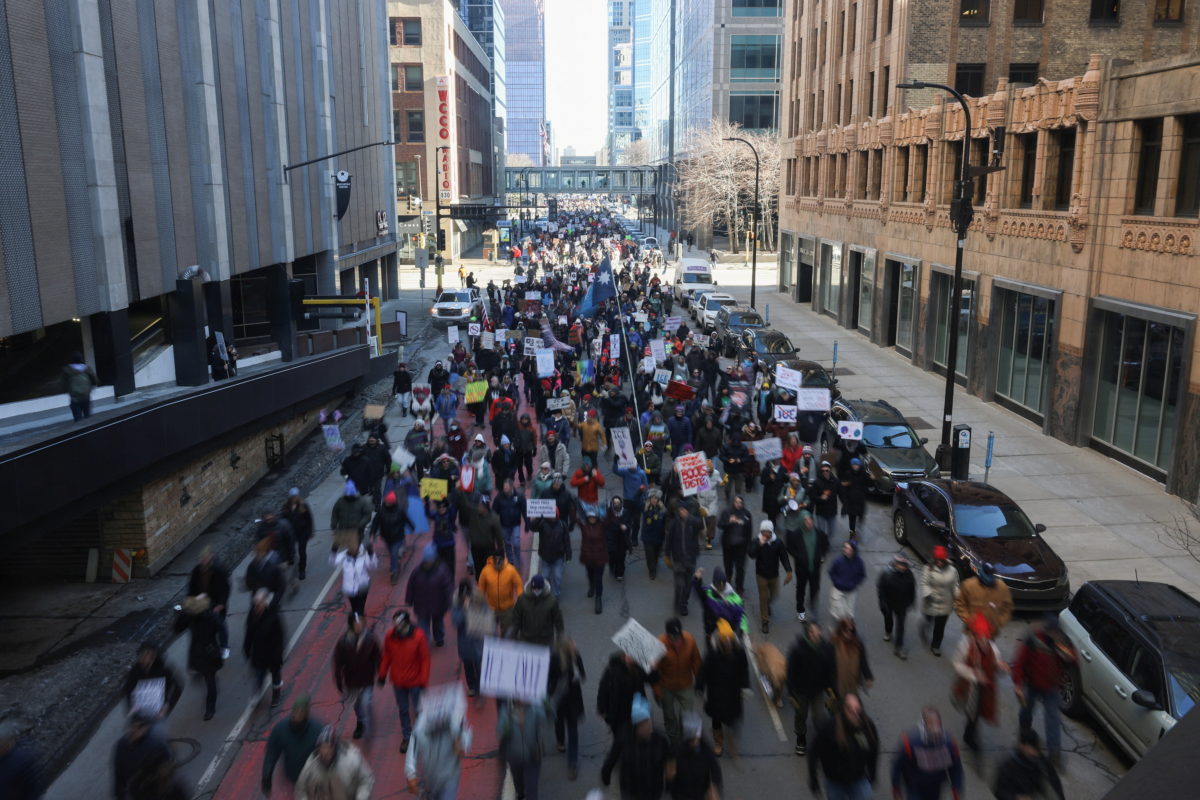
Federal prosecutors charge 15 people with conspiracy to impede agents during Minnesota immigration crackdown | PBS News
The defendants were each charged with conspiracy to impede or injury a federal officer, with some facing additional charges such as interstate stalking, destruction of government property and assault on a federal officer...

Saturday, March 14, 2026
Israeli military drops charges against soldiers accused of Gaza detainee abuse
Israel's top military lawyer has dropped all charges against five soldiers accused of the violent abuse and rape of a Palestinian detainee from Gaza...

Sunday, October 6, 2024
Thursday, April 25, 2024
Meadows, Giuliani and other Trump allies charged in Arizona 2020 election probe - The Washington Post
Those indicted include former Trump White House chief of staff Mark Meadows, attorneys Rudy Giuliani, Jenna Ellis, John Eastman and Christina Bobb, top campaign adviser Boris Epshteyn and former campaign aide Mike Roman. They are accused of allegedly aiding an unsuccessful strategy to award the state's electoral votes to Trump instead of Biden after the 2020 election. Also charged are the Republicans who signed paperwork on Dec. 14, 2020, that falsely purported Trump was the rightful winner, including former state party chair Kelli Ward, state Sens. Jake Hoffman and Anthony Kern, and Tyler Bowyer, a GOP national committeeman and chief operating officer of Turning Point Action, the campaign arm of the pro-Trump conservative group Turning Point USA...
Sunday, August 13, 2023
Trump allies face potential charges in Georgia over voting machine breaches
The Fulton county district attorney investigating Donald Trump's efforts to overturn the 2020 election results in Georgia has evidence to charge multiple allies of the former president involved in breaching voting machines in the state, according to two people briefed on the matter…
Wednesday, November 16, 2022
Trump D.C. hotel receipts reveal $10,500-a-night rooms for foreign officials seeking to influence U.S.
During Donald Trump's presidency, the governments of Saudi Arabia, the United Arab Emirates, Qatar, Turkey, China and Malaysia spent hundreds of thousands of dollars at the Trump International Hotel in Washington at the same time they were trying to influence U.S. foreign policy, according to investigative findings released Monday by the House Committee on Oversight and Reform...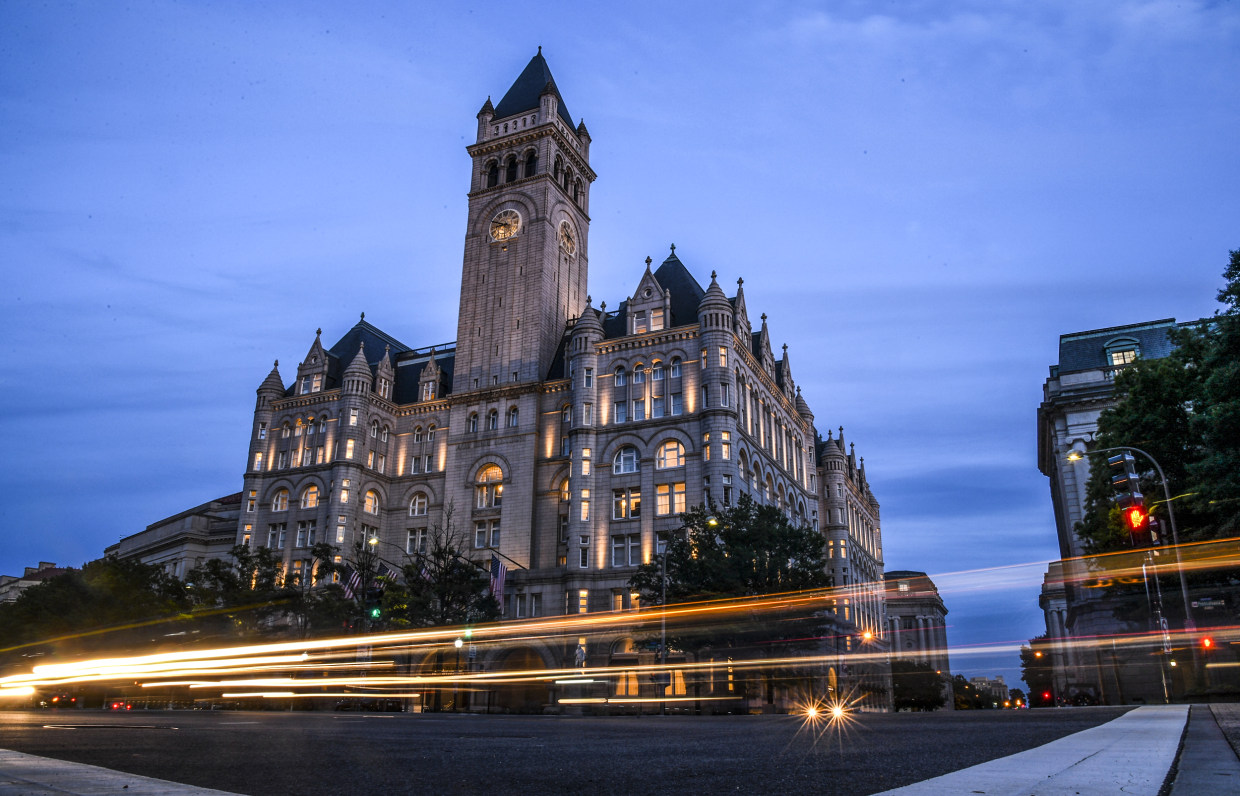
Saturday, January 1, 2022
Prosecutors break down charges, convictions for the 725 arrested so far for Jan. 6 attack on the U.S. Capitol - The Washington Post
…Of those arrested, 225 people were charged with assault or resisting arrest. More than 75 of those were charged with using a deadly or dangerous weapon against police officers. The office said 140 police officers, including Capitol officers and members of the D.C. police department, were victimized during the attack…
https://www.washingtonpost.com/politics/2021/12/31/capitol-deadly-attack-insurrection-arrested-convicted/
https://www.washingtonpost.com/politics/2021/12/31/capitol-deadly-attack-insurrection-arrested-convicted/

Thursday, January 28, 2021
Detroit dismissing most misdemeanor citations issued during George Floyd protests | TheHill
... Detroit will overall dismiss 238 of the 245 violations issued on the three days, The Associated Press reported,citing Garcia. The other charges, outside of curfew violations, were for disruptive or violent behavior, for which police made arrests...
Wednesday, January 13, 2021
Washington DC Attorney General makes HUGE announcement about charging Trump
BREAKING: The Washington DC attorney general just made a bombshell announcement about charging Trump.
Friday, January 8, 2021
Wednesday, August 12, 2020
Appeals court appears wary of dropping Flynn charges | TheHill
A federal appeals court on Tuesday appeared unsympathetic to arguments that it should order a district court judge to dismiss criminal charges against former national security adviser Michael Flynn.
The full D.C. Circuit Court of Appeals reheard oral arguments about how the Flynn case should proceed at the lower court after the Department of Justice (DOJ) suddenly moved to withdraw its case against the former adviser to President Trump.
https://thehill.com/regulation/court-battles/511512-appeals-court-appears-wary-of-dropping-flynn-charges

https://thehill.com/regulation/court-battles/511512-appeals-court-appears-wary-of-dropping-flynn-charges
Thursday, June 25, 2020
The Michael Flynn court ruling by Judge Neomi Rao is astonishingly bad - Vox
Judge Neomi Rao’s opinion in In re: Michael T. Flynn is simply astonishing.
It involves the Justice Department’s surprising decision to drop charges against one of President Trump’s former top aides — nearly three years after that aide plead guilty to lying to the FBI. And Rao’s opinion takes extraordinary liberties with the law.
https://www.vox.com/2020/6/24/21301826/michael-flynn-court-dismiss-charges-neomi-rao-karen-henderson-robert-wilkins
:format(webp)/cdn.vox-cdn.com/uploads/chorus_image/image/66977145/1094141328.jpg.0.jpg)
https://www.vox.com/2020/6/24/21301826/michael-flynn-court-dismiss-charges-neomi-rao-karen-henderson-robert-wilkins
Friday, June 12, 2020
DoJ push to dismiss Michael Flynn case a 'gross abuse of power', ex-judge finds
A former federal judge appointed to review the justice department’s motion to dismiss criminal charges against former national security adviser Michael Flynn has found that the government’s request should be denied because there is “clear evidence of a gross abuse of prosecutorial power”.
https://www.theguardian.com/us-news/2020/jun/10/michael-flynn-department-of-justice-trump

Wednesday, June 3, 2020
6 Atlanta Officers Charged After Release Of 'Disturbing' Arrest Video : NPR
Six Atlanta police officers are facing a slew of charges for their role in the arrest of two young people last weekend. The incident, during which officers used stun guns on the pair and pulled them from their vehicle, received national attention after bystanders recorded and posted video to social media.
https://www.npr.org/2020/06/02/868126089/6-atlanta-officers-charged-after-release-of-disturbing-arrest-video

Thursday, July 18, 2019
Booker demands answers from Barr on lack of charges in Garner killing - The Hill
Sen. Cory Booker (D-N.J.) criticized the Justice Department’s decision not to charge a New York police officer in the 2014 death of Eric Garner in a letter to Attorney General William Barr.....
https://thehill.com/homenews/senate/453579-booker-demands-answers-from-barr-on-lack-of-charges-in-garner-killing

https://thehill.com/homenews/senate/453579-booker-demands-answers-from-barr-on-lack-of-charges-in-garner-killing
Thursday, June 13, 2019
Supreme Court turns away appeal from longtime detainee at Guantanamo Bay - The Washington Post
The Supreme Court on Monday declined to hear the case of a Yemeni citizen detained as an enemy combatant for more than 17 years at the naval base at Guantanamo Bay, Cuba, without being charged with a crime.
The court turned down the petition of Moath Hamza Ahmed al-Alwi without comment. But Justice Stephen G. Breyer said the court may soon need to take such a case to decide whether Congress’s Authorization for Use of Military Force or the Constitution permits indefinite detention.....
https://www.washingtonpost.com/politics/courts_law/supreme-court-turns-away-appeal-from-longtime-detainee-at-guantanamo-bay/2019/06/10/3e7cc5ac-8b8e-11e9-adf3-f70f78c156e8_story.html

https://www.washingtonpost.com/politics/courts_law/supreme-court-turns-away-appeal-from-longtime-detainee-at-guantanamo-bay/2019/06/10/3e7cc5ac-8b8e-11e9-adf3-f70f78c156e8_story.html
Monday, June 10, 2019
The Priest Files: The Case of Father Richard Zula
Read the full Grand Jury report:
https://ffrf.org/uploads/legal/386201839-Interim-Redacted-Report-and-Responses.pdf
Father Richard Zula was ordained in 1966 and assigned to six different parishes through 1987. In 1987, the Diocese was under the command of Bishop Anthony Bevilacqua. In September of that year, the Diocese received a complaint that Zula had engaged in violent sexual activity with a minor at a rectory. This conduct involved three other adult males who were not priests.
On September 25, 1987, a meeting was held between Zula, Father Ted Rutkowski, Secretary for Clergy and Pastoral Life, and Father Robert Guay. Documentation of the meeting consisted of handwritten notes that included the name of the child victim at the top of the page, followed by three additional names and another notation of the victim's name. Among other things, this document listed "parties at Marianna rectory (assigned May 1984)"(1987 was the year when Zula became pastor at St. Clement), "alcohol, marijuana;" "oral sex, attempt anal sex, whips, rectory bedroom, offer to pay private room fee at St. V., present activity." This was followed by the notation, "Institute of Living Tues Sept 29" and the following notes: "No public celebration of mass, No return to parish once out, No communication with [victim] or family, No communication with others involved, Resignation from parish." Zula was subsequently sent to the Institute of Living, in Hartford, Connecticut on September 29, 1987.

On December 9, 1987, Rutkowski documented his thoughts that Zula was a "mama's boy" who was "pursued" by the victim. He also described the victim as being "16 - 17 years of age."
A confidential memorandum from Father Farmer to Rutkowski dated December 29, 1987, outlined three proposed scenarios for placing Zula back into ministry. Among other things, these proposals included assigning him as Chaplain at various parishes or assigning him to provide pastoral care at nursing homes.
Zula was discharged on January 13, 1988. The Diocese was advised that Zula again confessed his criminal conduct. He stated, "I got involved in some inappropriate sexual behavior and my bishop has sent me here for an evaluation." The summary further noted this other "individual" was "very sexually promiscuous and needy." The Grand Jury's review of these materials compels the conclusion that the Diocese was prepared to return yet another admitted child molester to ministry. Indeed, notes in Zula' s personnel file indicated that "re Zula" the "sooner reassigned the better." However, intervening and external factors changed that judgment.

In May, 1988, a summary of facts was prepared in connection with a lawsuit filed on behalf of victim against the Diocese of Pittsburgh. Among other things, the summary documented the victim's abuse, and the abuse of the victim's brother, by Fr. Robert Wolk. However, the summary also stated that at some point Wolk himself had criticized Zula for "having wild parties with drugs and alcohol."
By September 1988, a criminal investigation was underway. On September 22, 1988, the Pennsylvania State Police interviewed the victim who, among other things, reported that he was first sexually abused by Wolk in 1981. Zula then began sexually assaulting him in 1984 at which time the victim was still under the age of 16. The victim further advised that the sexual abuse occurred approximately once a week for another three years and that it included oral sex, sado- masochistic behavior, and attempts at anal sex. On November 10, 1988, an arrest warrant was issued for Zula. There is no indication that the Diocese disclosed their prior knowledge of Zula' s conduct or Zula' s confession to the police or to the public.
Zula was charged with over 130 counts related to child sexual abuse. His arrest generated significant press coverage. In the midst of the public outcry, Charles P. Nemeth, Esquire wrote a letter to the editor of the Pittsburgh Catholic magazine dated October 20, 1988. A copy of this letter was found within the Diocesan records. Among other things, Nemeth advised that he was a practicing Catholic and has been a criminal defense attorney for 10 years, which included representing sex offenders. Further, Nemeth advised that he held an LLM degree in Law Psychiatry and Criminology from Georgetown University. Nemeth then advised that he was "awe- struck by how reticent church officials are to condemn this activity as being criminal in scope and form." He criticized the "academic ponderings" and "other esoteric psychiatric diagnoses" that characterized child sexual abuse as "deviance and social aberration" and added that "in fact, it is probably one of the more heinous criminal activities that individuals can ever engage in. The reasons are self-evident." He then stated some of these reasons, which included the "higher standard of conduct" that should be required of priests; the "pedestal" on which priests are placed; that "sexual molestation between adults and minors is one of the most reprehensible forms of conduct outlined in statutory and codified law;" and that to "equate the social diseases of alcoholism and drug dependency with child molestation is an absolute and unadulterated folly."
In November 1988, personnel from the Diocese, including its attorney, met with the Western Regional Office of Children, Youth, and Families ("WROCYF"). A summary of the meeting was then provided to Wuerl in an April 24, 1989 letter from the WROCYF. Among other things, Wuerl was reminded that the Diocese was considered to be a "mandated reporter" of child abuse and thereby required to report any suspected cases of which it became aware. Further, Wuerl was notified that the Diocese was prohibited from conducting its own internal investigations to decide whether or not to report the abuse and was required to report it immediately. The letters exchanged between the WROCYF and the Bishop illustrated a disagreement as to whether the law's mandates applied to Diocesan personnel.
In the midst of this public scandal, on March 1, 1989, Wuerl authorized a confidential settlement between the Diocese and the family of the victim and his brother (who was also a victim) in the amount of a $500,000 lump sum with a separate amount of $400,000 to be paid over a period of 30 years. The settlement contained a "confidentiality agreement" which prohibited the victims from discussing the settlement or basis for the settlement with any third parties - unless agreed to by the Diocese. The settlement released the Bishop, the Diocese, and the Roman Catholic Church from any further liability with respect to the matter.
By the fall of 1989, Zula had entered a guilty plea to two counts and was awaiting sentencing. At that time, the Diocese began to receive additional complaints of child sexual abuse against Zula. Father Ron Lengwin documented a telephone call that he received from a parishioner on August 25, 1989. The caller advised that Zula had made frequent sexual advances on her son and at least two of his friends when they were 13 -year -old altar boys. The mother reported that Zula asked the boys to pose like statues and attempted to tie them up using rope. The Grand Jury found this mother's report to be consistent with the testimony of George. However, there was no indication that the Diocese reported this complaint to law enforcement. In fact, the Diocese was utilizing diocesan resources and personnel to advocate for Zula at his upcoming sentencing proceeding.
On October 23, 1989, Kenneth Stanko, a doctor obtained by the Diocese to work with Zula, wrote a letter to Father Rutkowski. Stanko enclosed a copy of his evaluation of Zula which he conducted for presentation at Zula' s sentencing. Stanko advised that this evaluation was also sent to the court. Among other things, Stanko opined that Zula' s "personality style is one of being passive -dependent and that he would not likely be a person to initiate sexual activity." By this letter, the Diocese was placed on notice that the services it had procured for Zula were being used as mitigation evidence at Zula' s sentencing. Moreover, these assertions blamed the child victim rather than the adult criminal.
Stanko wrote that Zula had admitted to "mutual masturbation and fellatio with one sixteen - year male" but only because "the boy first suggested sexual behaviors." Stanko further noted that Zula had also admitted to "mild sado-masochistic" behaviors with several boys. However, Stanko concluded that Zula "has never exhibited psychotic symptoms or any disturbance to his thinking and reasoning. I have never doubted his sincerity or honesty." The Grand Jury notes that while Diocesan resources were being used in such a fashion, unknowing parishioners were still actively tithing from their income without knowledge that church funds were being used to mitigate a convicted sex offender's sentence.
In preparation for Zula's sentencing, a press release issued by Wuerl stated, in part, " . . . the judicial system has run its course in arriving at its decision."
 In 1990, after Zula was sentenced to state prison, the Diocese agreed to set aside $500.00
per month until his release, at which time he would be paid the full amount in a lump sum. The
Diocese also informed Zula that he would not be given any new assignments and asked him to
consider requesting a dispensation from the priestly ministry. Zula responded in a letter dated September 11, 1990. He wrote that had the Diocese supported him, he may not have pleaded
guilty. He then accused the Diocese of paying for his treatment in order to "save their own hide."
Zula further advised that the District Attorney had offered to make a deal with him if he divulged
names of other priests involved in pedophilia and that he
In 1990, after Zula was sentenced to state prison, the Diocese agreed to set aside $500.00
per month until his release, at which time he would be paid the full amount in a lump sum. The
Diocese also informed Zula that he would not be given any new assignments and asked him to
consider requesting a dispensation from the priestly ministry. Zula responded in a letter dated September 11, 1990. He wrote that had the Diocese supported him, he may not have pleaded
guilty. He then accused the Diocese of paying for his treatment in order to "save their own hide."
Zula further advised that the District Attorney had offered to make a deal with him if he divulged
names of other priests involved in pedophilia and that he
In March, 1992, Zula informed the Diocese that he might be eligible for early release in July and requested that Wuerl confirm his future salary payments to assist him in obtaining his release. In response to Zula' s request, internal Diocesan documents revealed that Wuerl directed his subordinates to provide the requested information. The Diocese also agreed to increase Zula' s sustenance payments to $750 per month after his release and to provide him with medical coverage. When Zula was released in July, 1992, he received a check in the amount of $11,542.68 from the Diocese.

The Diocese continued to receive reports of past criminal conduct on the part of Zula after
his release. In a 1993 letter to Wuerl, a victim reported that Zula "systematically ask[ed] me to
strip, assume a kneeling position, have my hands tied by a closeline type rope and subject me to a
beating with various types of whips and leather straps." Shortly after this report, the Diocese
finally began "laicization," the process to remove Zula as a priest.
On January 20, 1995, Wuerl met with Zula to discuss his future salary and medical benefits. They discussed his dispensation from priestly vows but Zula was hesitant to agree to his removal because he did not think he could support himself. Zula suggested the possibility of a lump -sum payment which Wuerl referred to as "cushion income." After further discussion, Wuerl was open to the idea of Zula receiving a lump -sum payment of $180,000.00. Zula countered, however, with a request for "$240,000.00 (TAX FREE)." Additional internal documents indicated that the Diocese weighed Zula' s request. Three pages of undated handwritten notes with the heading "FROM THE DESK OF Father Guay" referenced Zula' s concern regarding his July, 1995 payments and the figures of $180,000 and $240,000. The words "slush fund - under table" were also included on the notes. Similarly, in a November 24, 1995 letter sent from Zula to Wuerl, Zula stated that he had recently met with Guay and Father Dinardo who informed him that if he were to resign from the active priestly ministry, he would still be entitled to receive his monthly sustenance payments and medical coverage. In light of this representation, Zula stated his desire to resign.
In 1996, the Diocese entered into a memorandum of understanding with Zula whereby he was allowed to resign and was prohibited from ever seeking future assignments within the Diocese. In return, the Diocese agreed that it would continue to pay him $750.00 per month for sustenance and provide medical coverage for him.
On January 31, 2001, another victim disclosed abuse by Zula. The victim reported that Zula asked him to remove his clothes so that he could beat him with a belt. On December 14, 2001, the Diocese increased Zula' s sustenance payments to $1,000 per month as of January, 2002.
In July, 2007 the Diocese learned that Zula had been volunteering at the Good Shepherd Church in Braddock. The Diocese dispatched a letter to Zula reminding him that such activity was not permitted.
https://ffrf.org/uploads/legal/386201839-Interim-Redacted-Report-and-Responses.pdf
Father Richard Zula was ordained in 1966 and assigned to six different parishes through 1987. In 1987, the Diocese was under the command of Bishop Anthony Bevilacqua. In September of that year, the Diocese received a complaint that Zula had engaged in violent sexual activity with a minor at a rectory. This conduct involved three other adult males who were not priests.
On September 25, 1987, a meeting was held between Zula, Father Ted Rutkowski, Secretary for Clergy and Pastoral Life, and Father Robert Guay. Documentation of the meeting consisted of handwritten notes that included the name of the child victim at the top of the page, followed by three additional names and another notation of the victim's name. Among other things, this document listed "parties at Marianna rectory (assigned May 1984)"(1987 was the year when Zula became pastor at St. Clement), "alcohol, marijuana;" "oral sex, attempt anal sex, whips, rectory bedroom, offer to pay private room fee at St. V., present activity." This was followed by the notation, "Institute of Living Tues Sept 29" and the following notes: "No public celebration of mass, No return to parish once out, No communication with [victim] or family, No communication with others involved, Resignation from parish." Zula was subsequently sent to the Institute of Living, in Hartford, Connecticut on September 29, 1987.

On December 9, 1987, Rutkowski documented his thoughts that Zula was a "mama's boy" who was "pursued" by the victim. He also described the victim as being "16 - 17 years of age."
A confidential memorandum from Father Farmer to Rutkowski dated December 29, 1987, outlined three proposed scenarios for placing Zula back into ministry. Among other things, these proposals included assigning him as Chaplain at various parishes or assigning him to provide pastoral care at nursing homes.
Zula was discharged on January 13, 1988. The Diocese was advised that Zula again confessed his criminal conduct. He stated, "I got involved in some inappropriate sexual behavior and my bishop has sent me here for an evaluation." The summary further noted this other "individual" was "very sexually promiscuous and needy." The Grand Jury's review of these materials compels the conclusion that the Diocese was prepared to return yet another admitted child molester to ministry. Indeed, notes in Zula' s personnel file indicated that "re Zula" the "sooner reassigned the better." However, intervening and external factors changed that judgment.

In May, 1988, a summary of facts was prepared in connection with a lawsuit filed on behalf of victim against the Diocese of Pittsburgh. Among other things, the summary documented the victim's abuse, and the abuse of the victim's brother, by Fr. Robert Wolk. However, the summary also stated that at some point Wolk himself had criticized Zula for "having wild parties with drugs and alcohol."
By September 1988, a criminal investigation was underway. On September 22, 1988, the Pennsylvania State Police interviewed the victim who, among other things, reported that he was first sexually abused by Wolk in 1981. Zula then began sexually assaulting him in 1984 at which time the victim was still under the age of 16. The victim further advised that the sexual abuse occurred approximately once a week for another three years and that it included oral sex, sado- masochistic behavior, and attempts at anal sex. On November 10, 1988, an arrest warrant was issued for Zula. There is no indication that the Diocese disclosed their prior knowledge of Zula' s conduct or Zula' s confession to the police or to the public.
Zula was charged with over 130 counts related to child sexual abuse. His arrest generated significant press coverage. In the midst of the public outcry, Charles P. Nemeth, Esquire wrote a letter to the editor of the Pittsburgh Catholic magazine dated October 20, 1988. A copy of this letter was found within the Diocesan records. Among other things, Nemeth advised that he was a practicing Catholic and has been a criminal defense attorney for 10 years, which included representing sex offenders. Further, Nemeth advised that he held an LLM degree in Law Psychiatry and Criminology from Georgetown University. Nemeth then advised that he was "awe- struck by how reticent church officials are to condemn this activity as being criminal in scope and form." He criticized the "academic ponderings" and "other esoteric psychiatric diagnoses" that characterized child sexual abuse as "deviance and social aberration" and added that "in fact, it is probably one of the more heinous criminal activities that individuals can ever engage in. The reasons are self-evident." He then stated some of these reasons, which included the "higher standard of conduct" that should be required of priests; the "pedestal" on which priests are placed; that "sexual molestation between adults and minors is one of the most reprehensible forms of conduct outlined in statutory and codified law;" and that to "equate the social diseases of alcoholism and drug dependency with child molestation is an absolute and unadulterated folly."
In November 1988, personnel from the Diocese, including its attorney, met with the Western Regional Office of Children, Youth, and Families ("WROCYF"). A summary of the meeting was then provided to Wuerl in an April 24, 1989 letter from the WROCYF. Among other things, Wuerl was reminded that the Diocese was considered to be a "mandated reporter" of child abuse and thereby required to report any suspected cases of which it became aware. Further, Wuerl was notified that the Diocese was prohibited from conducting its own internal investigations to decide whether or not to report the abuse and was required to report it immediately. The letters exchanged between the WROCYF and the Bishop illustrated a disagreement as to whether the law's mandates applied to Diocesan personnel.
In the midst of this public scandal, on March 1, 1989, Wuerl authorized a confidential settlement between the Diocese and the family of the victim and his brother (who was also a victim) in the amount of a $500,000 lump sum with a separate amount of $400,000 to be paid over a period of 30 years. The settlement contained a "confidentiality agreement" which prohibited the victims from discussing the settlement or basis for the settlement with any third parties - unless agreed to by the Diocese. The settlement released the Bishop, the Diocese, and the Roman Catholic Church from any further liability with respect to the matter.
By the fall of 1989, Zula had entered a guilty plea to two counts and was awaiting sentencing. At that time, the Diocese began to receive additional complaints of child sexual abuse against Zula. Father Ron Lengwin documented a telephone call that he received from a parishioner on August 25, 1989. The caller advised that Zula had made frequent sexual advances on her son and at least two of his friends when they were 13 -year -old altar boys. The mother reported that Zula asked the boys to pose like statues and attempted to tie them up using rope. The Grand Jury found this mother's report to be consistent with the testimony of George. However, there was no indication that the Diocese reported this complaint to law enforcement. In fact, the Diocese was utilizing diocesan resources and personnel to advocate for Zula at his upcoming sentencing proceeding.
On October 23, 1989, Kenneth Stanko, a doctor obtained by the Diocese to work with Zula, wrote a letter to Father Rutkowski. Stanko enclosed a copy of his evaluation of Zula which he conducted for presentation at Zula' s sentencing. Stanko advised that this evaluation was also sent to the court. Among other things, Stanko opined that Zula' s "personality style is one of being passive -dependent and that he would not likely be a person to initiate sexual activity." By this letter, the Diocese was placed on notice that the services it had procured for Zula were being used as mitigation evidence at Zula' s sentencing. Moreover, these assertions blamed the child victim rather than the adult criminal.
Stanko wrote that Zula had admitted to "mutual masturbation and fellatio with one sixteen - year male" but only because "the boy first suggested sexual behaviors." Stanko further noted that Zula had also admitted to "mild sado-masochistic" behaviors with several boys. However, Stanko concluded that Zula "has never exhibited psychotic symptoms or any disturbance to his thinking and reasoning. I have never doubted his sincerity or honesty." The Grand Jury notes that while Diocesan resources were being used in such a fashion, unknowing parishioners were still actively tithing from their income without knowledge that church funds were being used to mitigate a convicted sex offender's sentence.
In preparation for Zula's sentencing, a press release issued by Wuerl stated, in part, " . . . the judicial system has run its course in arriving at its decision."

could have named several priests; however, out of a sense of loyalty to my brother priests, and to try to protect the Church from any further scandal, I would not divulge their names, even to save myself from a jail term.Zula stated he would sign the petition for dispensation if the Diocese arranged for his release from prison first.
In March, 1992, Zula informed the Diocese that he might be eligible for early release in July and requested that Wuerl confirm his future salary payments to assist him in obtaining his release. In response to Zula' s request, internal Diocesan documents revealed that Wuerl directed his subordinates to provide the requested information. The Diocese also agreed to increase Zula' s sustenance payments to $750 per month after his release and to provide him with medical coverage. When Zula was released in July, 1992, he received a check in the amount of $11,542.68 from the Diocese.

On January 20, 1995, Wuerl met with Zula to discuss his future salary and medical benefits. They discussed his dispensation from priestly vows but Zula was hesitant to agree to his removal because he did not think he could support himself. Zula suggested the possibility of a lump -sum payment which Wuerl referred to as "cushion income." After further discussion, Wuerl was open to the idea of Zula receiving a lump -sum payment of $180,000.00. Zula countered, however, with a request for "$240,000.00 (TAX FREE)." Additional internal documents indicated that the Diocese weighed Zula' s request. Three pages of undated handwritten notes with the heading "FROM THE DESK OF Father Guay" referenced Zula' s concern regarding his July, 1995 payments and the figures of $180,000 and $240,000. The words "slush fund - under table" were also included on the notes. Similarly, in a November 24, 1995 letter sent from Zula to Wuerl, Zula stated that he had recently met with Guay and Father Dinardo who informed him that if he were to resign from the active priestly ministry, he would still be entitled to receive his monthly sustenance payments and medical coverage. In light of this representation, Zula stated his desire to resign.
In 1996, the Diocese entered into a memorandum of understanding with Zula whereby he was allowed to resign and was prohibited from ever seeking future assignments within the Diocese. In return, the Diocese agreed that it would continue to pay him $750.00 per month for sustenance and provide medical coverage for him.
On January 31, 2001, another victim disclosed abuse by Zula. The victim reported that Zula asked him to remove his clothes so that he could beat him with a belt. On December 14, 2001, the Diocese increased Zula' s sustenance payments to $1,000 per month as of January, 2002.
In July, 2007 the Diocese learned that Zula had been volunteering at the Good Shepherd Church in Braddock. The Diocese dispatched a letter to Zula reminding him that such activity was not permitted.
Tuesday, May 28, 2019
The Priest Files: The Case of Father George Zirwas
Read the full Pennsuylvania Grand Jury report:
https://ffrf.org/uploads/legal/386201839-Interim-Redacted-Report-and-Responses.pdf
Father George Zirwas was ordained in September 1979. Zirwas was assigned to eight different parishes as Parochial Vicar until 1995 when he was placed on a leave of absence. He appeared to have remained in this status until his death in May 2001.
On September 1, 2016, the Pennsylvania Office of Attorney General served the Diocese of Pittsburgh with a Grand Jury subpoena requesting any and all documents related to clergy members or diocesan leadership personnel who had been accused of sexually abusing children. In response, the Diocese produced thousands of documents. In the course of this investigation, the Grand Jury took testimony from live witnesses, reviewed Diocesan records, and consulted with experts from the Federal Bureau of Investigation in the field of behavioral analysis. However, the Grand Jury learned that some original documents related to deceased priests were intentionally destroyed by the Diocese. Fortunately, Canon 489 of the Canon Law governing the operations of the Roman Catholic Church requires the maintenance of a summary of the facts and any text of a definitive judgement. In the case of Zirwas, while many original records were destroyed, the summary of meetings, memoranda, and Diocesan actions remained.
The Grand Jury learned that the Diocese was aware of complaints against Zirwas for sexually abusing children as early as 1987. Additional complaints were received between 1987 and 1995. However, Zirwas continued to function as a priest during this period and was reassigned to several parishes.
Documents obtained by the Grand Jury from the secret or confidential files of the Diocese recorded that in October, 1987, Father Garbin met with a little boy and his family about an "incident of inappropriate touch" by Zirwas at St. Joseph the Worker parish. No action was taken by Bishop Anthony Bevilacqua, nor the Diocese, and Zirwas remained in ministry.
In February, 1988, another internal memorandum recorded that Father Ted Rutkowski met with Zirwas. The meeting was arranged after Zirwas was accused of unwanted sexual contact with a young man. Zirwas admitted to having contact with the young man in multiple parish rectories and explained that the young man had asked Zirwas to massage his legs. Zirwas stated that he massaged his legs, but did nothing more. He noted that sometime after the contact, the "boy left, then the allegation came." Zirwas was thereafter sent to St. Francis Hospital for an evaluation in March, 1988. Upon his release, he continued in ministry.
In November, 1988, Diocesan officials met with a mother who reported that her 16 -year- old son was given alcohol by Zirwas and that Zirwas fondled the boy's genitals. That same month, the Diocese received another report from a victim who revealed that he was groped by Zirwas when he was 17 years old. Zirwas was sent to St. Luke's Institute for an evaluation in December, 1988. Upon his release he once again continued in ministry.
The Grand Jury notes that where any institution or individual destroys evidence of a crime when an investigation is about to be instituted, such conduct could be pursued as a criminal offense in Pennsylvania under 18 Pa. C.S.A. §4910, Tampering with or Fabricating Physical Evidence.
Internal assignment records documented that from January, 1989 until June, 1989 Zirwas served as Parochial Vicar of St. Michael. From June, 1989 to December, 1991, he served at St. Bartholomew as Parochial Vicar. In June, 1991, a meeting was held between Father David Zubick, Father Downs, and Father Robert Guay with respect to a victim's complaint regarding his contact with Zirwas. Among other things, this victim reported that Zirwas massaged his feet, calves, thighs, and then groped his penis. The victim informed the Diocese that he was too embarrassed to speak publically regarding the abuse or go to court.
In December, 1991, Zirwas was reassigned to St. Scholastica as Parochial Vicar. Then, in May, 1994, Zirwas was again reassigned to St. Joseph as Parochial Vicar. Diocesan records, obtained by the Grand Jury, revealed that Zirwas was then placed on a leave of absence for "personal reasons" in December, 1994.
In July, 1995, Zirwas met with Zubik and requested permission to take an assignment in Miami, Florida. Zirwas stated that his desire to leave the Diocese was due to "false rumors about him." Zirwas threatened to pursue legal action against other Diocesan personnel for "raising the consciousness of some of the people at St. Joseph Parish concerning his relationship to the public scandals which surfaced in 1988." This meeting was memorialized in a confidential internal memorandum obtained by the Grand Jury.
Within days, Zirwas was returned to ministry by Bishop Donald Wuerl. In 1995, Zirwas was ssigned as Parochial Vicar of St. Maurice. In November, 1995, the Diocese received another complaint from a victim who reported that Zirwas fondled him and performed oral sex on him when he was approximately 15 years old. In response, Zirwas was again placed on a leave of absence for "personal reasons." A status he would keep until the time of his death.
In January, 1996, a mother of a victim demanded a meeting with the Diocese. That meeting was granted. Diocesan records noted the mother's outrage and disappointment. She stated that she had originally reported her son's abuse in 1988 and believed that proper action would be taken to remove Zirwas from ministry. However, she learned that this did not occur. She noted that she had written at least one letter and received no response. Moreover, when she pursued the matter, she was told by Father Ted Rutkowski that it was "a one-time occurrence and that it had been handled."
After being placed on a leave of absence in 1995, Zirwas relocated to Florida before ultimately moving to Cuba. Zirwas' s activities in Florida and Cuba are largely unknown and no detailed Diocesan records were provided to the Grand Jury. However, in 1996, Zirwas informed the Diocese that he had knowledge of other Pittsburgh Diocese priests' involvement in illegal sexual activity. In exchange for this information, he demanded that his sustenance payments be increased.
In response to this request, Wuerl instructed him to document in writing the names of the priests involved, or, state that he had no knowledge of what he had previously claimed. Wuerl advised that this action had to be undertaken before Zirwas could receive any additional assistance. After Zirwas disavowed any knowledge of priest involvement in illegal sexual activity in a letter to the Diocese, he was granted an additional financial stipend and his sustenance payments were continued. Zirwas continued to work with the poor and needy in Cuba until May 2001, when he was murdered inside his Havana apartment.
During the course of this investigation, the Grand Jury uncovered a ring of predatory priests operating within the Diocese who shared intelligence or information regarding victims as well as exchanging the victims amongst themselves. This ring also manufactured child pornography on Diocesan property, including parishes and rectories. This group included: Zirwas, Francis Pucci, Robert Wolk, and Richard Zula. This group of priests used whips, violence and sadism in raping their victims.
On December 17, 2017, a victim (hereinafter identified as "George") appeared before the Grand Jury to provide information regarding his sexual abuse as a child by priests in the Diocese. George's experience is not only a personal tragedy but an institutional tragedy. His testimony corroborated evidence found within Diocesan records that predatory priests existed; that these predators shared information; and, that these men sexually offended on children.
George was raised as a Catholic and attended Catholic School from first through twelfth grade. While at St. Adalbert' s on the South Side of Pittsburgh, George served as an altar boy.
George became friends with Zirwas in the mid -1970's. Zirwas would spend time at George's home and take George to lunch or dinner on occasion. George's family encouraged the contact with Zirwas based upon the belief that Zirwas would be a good influence on George. George noted that that his Catholic family looked at priests as "very truth worthy, very elevated." As George was transitioning from middle school to high school, Zirwas took him on trips, took him to see St. Paul Seminary, and, even taught him how to drive. Over time, Zirwas began to take George with him as he carried out priestly duties and on his visits with parishioners.
Zirwas started introducing George to his "friends" who were priests who seemed to share similar interests. On one occasion, Zirwas took George to a parish rectory in Munhall where the following priests were present: Father Francis L. Pucci, Father Richard Zula, and Father Francis Luddy of the Diocese of Altoona -Johnstown. The priests began a conversation about religious statues and asked George to get up on a bed. As the priests watched, they asked George to remove his shirt. They then drew an analogy to the image of Christ on the cross, and told George to remove his pants so that his pose would be more consistent with the image of Christ in a loincloth. At that point, the priests began taking Polaroid pictures of George. As the picture taking continued, the priests directed George to take off his underwear. George was nervous and complied.
George recalled that either Zula or Pucci operated the camera. He stated that all of the men giggled and stated that the pictures would be used as a reference for new religious statues for the parishes. George testified that this occurred before he turned 18 -years -old and that his genitals were exposed in the photographs. George stated that his photographs were added to a collection of similar photographs depicting other teenage boys.
George recalled that each of these priests had a group of favored boys who they would take on trips. The boys received gifts; specifically, gold cross necklaces. George stated, "He [Zirwas] had told me that they, the priests, would give their boys, their altar boys or their favorite boys these crosses. So he gave me a big gold cross to wear."
The Grand Jury observed that these crosses served another purpose beyond the grooming of the victims: They were a visible designation that these children were victims of sexual abuse. They were a signal to other predators that the children had been desensitized to sexual abuse and were optimal targets for further victimization.
George still has the cross and it was shown to the Grand Jury.

The Grand Jury noted that George's testimony revealed how a group of priests, all offenders in their own right, collaborated together to manufacture child pornography within the Diocese of Pittsburgh. George's last contact with Zirwas occurred prior to his departure to join the United States military. However, other boys became victims of abuse.
In 1988, the Allegheny County District Attorney's Office charged Zula, Pucci and Wolk with sexually assaulting two altar boys. Zula pled guilty and was sentenced to up to five years in prison. Wolk was sentenced to up to ten years in prison. Pucci' s charges were dropped because the criminal statute of limitations had expired.
Zula was a pastor at Saints Mary and Ann Church in Marianna Wolk had been a pastor of St. Thomas Church in Bethel Park.
George testified that he looks back now with disdain. He questions how this activity could occur, involve multiple priests, and not have created suspicion on the part of Diocesan administrators. George stated,
After Zirwas' death in 2001, the spokesman for the Diocese was interviewed by the Pittsburgh Post -Gazette. Among other things, the Diocese refused to disclose any of the reasons why Zirwas was placed on a leave of absence, citing the confidentiality of his personnel files.
However, when Wuerl presided over Zirwas' funeral, he stated, among other things, that "a priest is a priest. Once he is ordained, he is a priest forever."
https://ffrf.org/uploads/legal/386201839-Interim-Redacted-Report-and-Responses.pdf
Father George Zirwas was ordained in September 1979. Zirwas was assigned to eight different parishes as Parochial Vicar until 1995 when he was placed on a leave of absence. He appeared to have remained in this status until his death in May 2001.
On September 1, 2016, the Pennsylvania Office of Attorney General served the Diocese of Pittsburgh with a Grand Jury subpoena requesting any and all documents related to clergy members or diocesan leadership personnel who had been accused of sexually abusing children. In response, the Diocese produced thousands of documents. In the course of this investigation, the Grand Jury took testimony from live witnesses, reviewed Diocesan records, and consulted with experts from the Federal Bureau of Investigation in the field of behavioral analysis. However, the Grand Jury learned that some original documents related to deceased priests were intentionally destroyed by the Diocese. Fortunately, Canon 489 of the Canon Law governing the operations of the Roman Catholic Church requires the maintenance of a summary of the facts and any text of a definitive judgement. In the case of Zirwas, while many original records were destroyed, the summary of meetings, memoranda, and Diocesan actions remained.
The Grand Jury learned that the Diocese was aware of complaints against Zirwas for sexually abusing children as early as 1987. Additional complaints were received between 1987 and 1995. However, Zirwas continued to function as a priest during this period and was reassigned to several parishes.
Documents obtained by the Grand Jury from the secret or confidential files of the Diocese recorded that in October, 1987, Father Garbin met with a little boy and his family about an "incident of inappropriate touch" by Zirwas at St. Joseph the Worker parish. No action was taken by Bishop Anthony Bevilacqua, nor the Diocese, and Zirwas remained in ministry.
In February, 1988, another internal memorandum recorded that Father Ted Rutkowski met with Zirwas. The meeting was arranged after Zirwas was accused of unwanted sexual contact with a young man. Zirwas admitted to having contact with the young man in multiple parish rectories and explained that the young man had asked Zirwas to massage his legs. Zirwas stated that he massaged his legs, but did nothing more. He noted that sometime after the contact, the "boy left, then the allegation came." Zirwas was thereafter sent to St. Francis Hospital for an evaluation in March, 1988. Upon his release, he continued in ministry.
In November, 1988, Diocesan officials met with a mother who reported that her 16 -year- old son was given alcohol by Zirwas and that Zirwas fondled the boy's genitals. That same month, the Diocese received another report from a victim who revealed that he was groped by Zirwas when he was 17 years old. Zirwas was sent to St. Luke's Institute for an evaluation in December, 1988. Upon his release he once again continued in ministry.
The Grand Jury notes that where any institution or individual destroys evidence of a crime when an investigation is about to be instituted, such conduct could be pursued as a criminal offense in Pennsylvania under 18 Pa. C.S.A. §4910, Tampering with or Fabricating Physical Evidence.
Internal assignment records documented that from January, 1989 until June, 1989 Zirwas served as Parochial Vicar of St. Michael. From June, 1989 to December, 1991, he served at St. Bartholomew as Parochial Vicar. In June, 1991, a meeting was held between Father David Zubick, Father Downs, and Father Robert Guay with respect to a victim's complaint regarding his contact with Zirwas. Among other things, this victim reported that Zirwas massaged his feet, calves, thighs, and then groped his penis. The victim informed the Diocese that he was too embarrassed to speak publically regarding the abuse or go to court.
In December, 1991, Zirwas was reassigned to St. Scholastica as Parochial Vicar. Then, in May, 1994, Zirwas was again reassigned to St. Joseph as Parochial Vicar. Diocesan records, obtained by the Grand Jury, revealed that Zirwas was then placed on a leave of absence for "personal reasons" in December, 1994.
In July, 1995, Zirwas met with Zubik and requested permission to take an assignment in Miami, Florida. Zirwas stated that his desire to leave the Diocese was due to "false rumors about him." Zirwas threatened to pursue legal action against other Diocesan personnel for "raising the consciousness of some of the people at St. Joseph Parish concerning his relationship to the public scandals which surfaced in 1988." This meeting was memorialized in a confidential internal memorandum obtained by the Grand Jury.
Within days, Zirwas was returned to ministry by Bishop Donald Wuerl. In 1995, Zirwas was ssigned as Parochial Vicar of St. Maurice. In November, 1995, the Diocese received another complaint from a victim who reported that Zirwas fondled him and performed oral sex on him when he was approximately 15 years old. In response, Zirwas was again placed on a leave of absence for "personal reasons." A status he would keep until the time of his death.
In January, 1996, a mother of a victim demanded a meeting with the Diocese. That meeting was granted. Diocesan records noted the mother's outrage and disappointment. She stated that she had originally reported her son's abuse in 1988 and believed that proper action would be taken to remove Zirwas from ministry. However, she learned that this did not occur. She noted that she had written at least one letter and received no response. Moreover, when she pursued the matter, she was told by Father Ted Rutkowski that it was "a one-time occurrence and that it had been handled."
After being placed on a leave of absence in 1995, Zirwas relocated to Florida before ultimately moving to Cuba. Zirwas' s activities in Florida and Cuba are largely unknown and no detailed Diocesan records were provided to the Grand Jury. However, in 1996, Zirwas informed the Diocese that he had knowledge of other Pittsburgh Diocese priests' involvement in illegal sexual activity. In exchange for this information, he demanded that his sustenance payments be increased.
In response to this request, Wuerl instructed him to document in writing the names of the priests involved, or, state that he had no knowledge of what he had previously claimed. Wuerl advised that this action had to be undertaken before Zirwas could receive any additional assistance. After Zirwas disavowed any knowledge of priest involvement in illegal sexual activity in a letter to the Diocese, he was granted an additional financial stipend and his sustenance payments were continued. Zirwas continued to work with the poor and needy in Cuba until May 2001, when he was murdered inside his Havana apartment.
During the course of this investigation, the Grand Jury uncovered a ring of predatory priests operating within the Diocese who shared intelligence or information regarding victims as well as exchanging the victims amongst themselves. This ring also manufactured child pornography on Diocesan property, including parishes and rectories. This group included: Zirwas, Francis Pucci, Robert Wolk, and Richard Zula. This group of priests used whips, violence and sadism in raping their victims.
On December 17, 2017, a victim (hereinafter identified as "George") appeared before the Grand Jury to provide information regarding his sexual abuse as a child by priests in the Diocese. George's experience is not only a personal tragedy but an institutional tragedy. His testimony corroborated evidence found within Diocesan records that predatory priests existed; that these predators shared information; and, that these men sexually offended on children.
George was raised as a Catholic and attended Catholic School from first through twelfth grade. While at St. Adalbert' s on the South Side of Pittsburgh, George served as an altar boy.
George became friends with Zirwas in the mid -1970's. Zirwas would spend time at George's home and take George to lunch or dinner on occasion. George's family encouraged the contact with Zirwas based upon the belief that Zirwas would be a good influence on George. George noted that that his Catholic family looked at priests as "very truth worthy, very elevated." As George was transitioning from middle school to high school, Zirwas took him on trips, took him to see St. Paul Seminary, and, even taught him how to drive. Over time, Zirwas began to take George with him as he carried out priestly duties and on his visits with parishioners.
Zirwas started introducing George to his "friends" who were priests who seemed to share similar interests. On one occasion, Zirwas took George to a parish rectory in Munhall where the following priests were present: Father Francis L. Pucci, Father Richard Zula, and Father Francis Luddy of the Diocese of Altoona -Johnstown. The priests began a conversation about religious statues and asked George to get up on a bed. As the priests watched, they asked George to remove his shirt. They then drew an analogy to the image of Christ on the cross, and told George to remove his pants so that his pose would be more consistent with the image of Christ in a loincloth. At that point, the priests began taking Polaroid pictures of George. As the picture taking continued, the priests directed George to take off his underwear. George was nervous and complied.
George recalled that either Zula or Pucci operated the camera. He stated that all of the men giggled and stated that the pictures would be used as a reference for new religious statues for the parishes. George testified that this occurred before he turned 18 -years -old and that his genitals were exposed in the photographs. George stated that his photographs were added to a collection of similar photographs depicting other teenage boys.
George recalled that each of these priests had a group of favored boys who they would take on trips. The boys received gifts; specifically, gold cross necklaces. George stated, "He [Zirwas] had told me that they, the priests, would give their boys, their altar boys or their favorite boys these crosses. So he gave me a big gold cross to wear."
The Grand Jury observed that these crosses served another purpose beyond the grooming of the victims: They were a visible designation that these children were victims of sexual abuse. They were a signal to other predators that the children had been desensitized to sexual abuse and were optimal targets for further victimization.
George still has the cross and it was shown to the Grand Jury.

The Grand Jury noted that George's testimony revealed how a group of priests, all offenders in their own right, collaborated together to manufacture child pornography within the Diocese of Pittsburgh. George's last contact with Zirwas occurred prior to his departure to join the United States military. However, other boys became victims of abuse.
In 1988, the Allegheny County District Attorney's Office charged Zula, Pucci and Wolk with sexually assaulting two altar boys. Zula pled guilty and was sentenced to up to five years in prison. Wolk was sentenced to up to ten years in prison. Pucci' s charges were dropped because the criminal statute of limitations had expired.
Zula was a pastor at Saints Mary and Ann Church in Marianna Wolk had been a pastor of St. Thomas Church in Bethel Park.
George testified that he looks back now with disdain. He questions how this activity could occur, involve multiple priests, and not have created suspicion on the part of Diocesan administrators. George stated,
To me, between going to St. Paul Seminary, Father Zula, Father Pucci, that there was just an insidious pedophile community that permeated through at least the Pittsburgh Diocese. And you know, my assumption as I grow older is that this was something that was happening all over the United States and it just - you know, it is very disappointing.George went on to explain his reluctance to come forward, stating,
I don't think there was anybody I could trust to tell, number 1. There was never - who do you tell? Like, at the time, I was a tough kid from the South Side. It didn't like - I just kind of - I was a survivor at the time. So that was just part of the lifestyle, I guess, and you know, I just kind of moved on... as a man, you know, who do you want to tell that other priests took pictures of you. It was pretty degrading. It is humiliating. I know some people it went further than that. I'm lucky it hasn't. It is still really hard to get it out there that you were in a room when you were 14 or 15 and getting naked pictures taken from priests.George's testimony to the Grand Jury was one of the first times he had ever disclosed his abuse. The Grand Jury's review of records revealed that the Diocese was aware of the conduct of these predatory priests and the records corroborated George's testimony. It does not appear that the Diocese disclosed any information to the police during the prosecution of some of these offenders in the late 1980's. Moreover, it does not appear that the Diocese shared with the police Zirwas' s statement that he had information on other priests' criminal activity.
After Zirwas' death in 2001, the spokesman for the Diocese was interviewed by the Pittsburgh Post -Gazette. Among other things, the Diocese refused to disclose any of the reasons why Zirwas was placed on a leave of absence, citing the confidentiality of his personnel files.
However, when Wuerl presided over Zirwas' funeral, he stated, among other things, that "a priest is a priest. Once he is ordained, he is a priest forever."
Sunday, May 26, 2019
5 Catholic priests charged in Michigan sex abuse investigation
As part of the state's investigation into sexual abuse by Catholic clergy, Michigan Attorney General Dana Nessel announced Friday criminal sexual conduct charges against five priests in Michigan.

Thursday, February 14, 2019
Trump Supporter Who Attacked BBC Cameraman at Rally May Not Be Charged: El Paso DA -The Daily Beast
During the El Paso rally Monday night, a Trumpkin "violently pushed" a BBC cameraman. The DA's office says it will not press charges. ....
https://www.thedailybeast.com/trump-supporter-who-attacked-bbc-cameraman-at-rally-wont-be-charged-el-paso-da

https://www.thedailybeast.com/trump-supporter-who-attacked-bbc-cameraman-at-rally-wont-be-charged-el-paso-da
Subscribe to:
Posts (Atom)

Click Older Posts above to see more.