Interview:
Showing posts with label loneliness. Show all posts
Sunday, July 27, 2025
Can religion cure loneliness? (Dan Barker and Annie Laurie Gaylor, Freethought Radio podcast)
This week on Freethought Radio, guest hosts Ryan Jayne and Leo Costello talk about a Christian state representative in Texas who’s speaking out against a new law that would place the Ten Commandments in every public school in the state. Plus, we listen to debates featuring FFRF co-presidents Annie Laurie Gaylor and Dan Barker as they address the questions “Is religion a force for good?” and “Can religion cure the loneliness epidemic?”
Friday, November 24, 2023
Healing the 'Invisible Ache' behind the suicide crisis among Black men and boys (Tonya Mosley; Fresh Air podcast)
Actor Courtney B. Vance was a young actor on Broadway in the 1990s when he received a call from his mother that would tear his world apart: His father was dead, she said, by suicide. Years later, Vance's godson, a promising college student, would also die by suicide.
In the wake of these devastating losses, Vance has focused on peeling back the layers of both his father's pain and his own struggles as a Black man in America. In a new book, The Invisible Ache, Vance and psychologist Robin L. Smith (who often goes by Dr. Robin) explore the trauma unique to Black men and boys, and address what they see as an urgent need to change the conversation about mental health.
"[With] Black boys and Black men, the rates of suicide is increasing," Smith says. "The rate is accelerating faster than any other group in the country, in the United States. And so we have to ask why."
Smith points to a modern culture of isolation and loneliness, which the surgeon general has referred to as a public health emergency. But, she adds, those factors are compounded for Black men and boys.
"If we then put race and racism with isolation and loneliness, surely we understand that Black boys and Black men are up against historical trauma as well as current-day trauma," Smith says.
Though the book is focused on the mental health of Black boys and men, Vance says the issue has universal implications: "We are all interconnected. ... My ache is your ache. If I'm aching, [and] you [are] clutching your purse as I walk by, you're aching. You're as much in a prison as I am," he says.
Interview:
In the wake of these devastating losses, Vance has focused on peeling back the layers of both his father's pain and his own struggles as a Black man in America. In a new book, The Invisible Ache, Vance and psychologist Robin L. Smith (who often goes by Dr. Robin) explore the trauma unique to Black men and boys, and address what they see as an urgent need to change the conversation about mental health.
"[With] Black boys and Black men, the rates of suicide is increasing," Smith says. "The rate is accelerating faster than any other group in the country, in the United States. And so we have to ask why."
Smith points to a modern culture of isolation and loneliness, which the surgeon general has referred to as a public health emergency. But, she adds, those factors are compounded for Black men and boys.
"If we then put race and racism with isolation and loneliness, surely we understand that Black boys and Black men are up against historical trauma as well as current-day trauma," Smith says.
Though the book is focused on the mental health of Black boys and men, Vance says the issue has universal implications: "We are all interconnected. ... My ache is your ache. If I'm aching, [and] you [are] clutching your purse as I walk by, you're aching. You're as much in a prison as I am," he says.
Interview:
Tuesday, August 8, 2023
The weaponization of loneliness
Long before Bannon ran Donald Trump's presidential campaign, he was involved in the world of online gaming. He discovered an army of what he later described as "rootless white males," disconnected from the real world but highly engaged online and often quick to resort to sexist and racist attacks. When Bannon took over the hard-right website Breitbart News, he was determined to turn these socially isolated gamers into the shock troops of the alt-right, pumping them full of conspiracy theories and hate speech. Bannon pursued the same project as a senior executive at Cambridge Analytica, the notorious data-mining and online-influence company largely owned by the right-wing billionaire Robert Mercer. According to a former Cambridge Analytica engineer turned whistleblower, Bannon targeted "incels," or involuntarily celibate men, because they were easy to manipulate and prone to believing conspiracy theories. "You can activate that army," Bannon told the Bloomberg journalist Joshua Green. "They come in through Gamergate or whatever and then get turned onto politics and Trump."
Sunday, November 29, 2020
Vivek Murthy on America’s loneliness epidemic (The Ezra Klein Show podcast)
At the holidays, I wanted to share some of my favorite episodes of the show with you (we’ll be back next week with brand new episodes). My conversation with Vivek Murthy tops that list, and it has particular force this Thanksgiving, when so many are alone on a day when connection means so much.
c
As US surgeon general from 2014 to 2017, Murthy visited communities across the United States to talk about issues like addiction, obesity, and mental illness. But he found that what Americans wanted to talk to him about the most was loneliness. In a 2018 report by the Kaiser Family Foundation, 22 percent of all adults in the US — almost 60 million Americans — said they often or always felt lonely or socially isolated.
Murthy went on to write Together: The Healing Power of Human Connection in a Sometimes Lonely World, and was recently named one of the co-chairs of Joe Biden’s coronavirus task force. Those projects may sound different, but they connect: Coronavirus has made America’s loneliness crisis far worse. Social distancing, while necessary from a public health standpoint, has caused a collapse in social contact among family, friends, and entire communities. And the people most vulnerable to the virus — the elderly, the disabled, the ill — are also unusually likely to suffer from loneliness.
Murthy’s explanation of how loneliness acts on the body is worth the time, all on its own — it’ll change how you see the relationship between social experience and physical health. But the broader message here is deeper: You are not alone in your loneliness. None of us are. And the best thing we can do for our own feeling of isolation is often to help someone else out of the very pit we’re in.
Interview:
Murthy went on to write Together: The Healing Power of Human Connection in a Sometimes Lonely World, and was recently named one of the co-chairs of Joe Biden’s coronavirus task force. Those projects may sound different, but they connect: Coronavirus has made America’s loneliness crisis far worse. Social distancing, while necessary from a public health standpoint, has caused a collapse in social contact among family, friends, and entire communities. And the people most vulnerable to the virus — the elderly, the disabled, the ill — are also unusually likely to suffer from loneliness.
Murthy’s explanation of how loneliness acts on the body is worth the time, all on its own — it’ll change how you see the relationship between social experience and physical health. But the broader message here is deeper: You are not alone in your loneliness. None of us are. And the best thing we can do for our own feeling of isolation is often to help someone else out of the very pit we’re in.
Sunday, July 21, 2019
Yes, spending time alone can be good for you - The Hill
There are even several benefits, or what are called "self-enhancing" functions of alone time. In general, when people voluntarily spend time alone, they counterintuitively report higher levels of well-being.....
https://thehill.com/opinion/healthcare/453089-yes-spending-time-alone-can-be-good-for-you
Tuesday, January 1, 2019
For Rent: Senior Citizens Turn To Roommates For Companionship, Cost-Cutting (Meghna Chakrabarti, On Point)
Real-life “Golden Girls.” Senior citizens getting roommates to ease financial pressures and fight loneliness. It’s a growing trend.
Interview:
Saturday, July 7, 2018
Four ways to prevent loneliness from wrecking your retirement - Reuters
When Monica Dwyer of West Chester, Ohio thinks of retirement, her mind wanders to her family friend Paul. ....
https://www.reuters.com/article/us-money-retirement-loneliness/four-ways-to-prevent-loneliness-from-wrecking-your-retirement-idUSKBN1JS15Z
Sunday, March 11, 2018
The Loneliness Epidemic (Tom Ashbrook, On Point)
Loneliness is now an epidemic , and as bad for us as smoking. We're looking at the high costs of emotional isolation.
Interview:
http://www.wbur.org/onpoint/2018/01/23/the-loneliness-epidemic
Interview:
http://www.wbur.org/onpoint/2018/01/23/the-loneliness-epidemic
Saturday, October 14, 2017
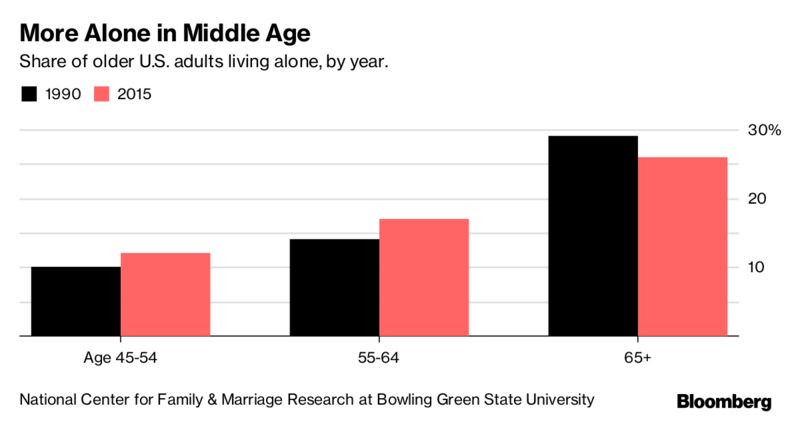
Americans Face a Rising Risk of Dying Alone -- Bloomberg
Loneliness kills. Life without friends and family is not just dreary but difficult, especially as we get older. Strong social relationships boost a person's chances of staying alive by 50 percent, according to a comprehensive 2010 review of 148 studies that followed 309,000 people for an average of 7.5 years. That's about the same improvement to mortality as the one that comes from quitting smoking. ....
https://www.bloomberg.com/news/articles/2017-10-09/americans-face-a-rising-risk-of-dying-alone
Subscribe to:
Posts (Atom)