Donald Trump floated recycled false 2020 election claims during a national address Thursday night.
Kash Patel fired two FBI intelligence analysts that refused to join the investigation into Georgia elections.
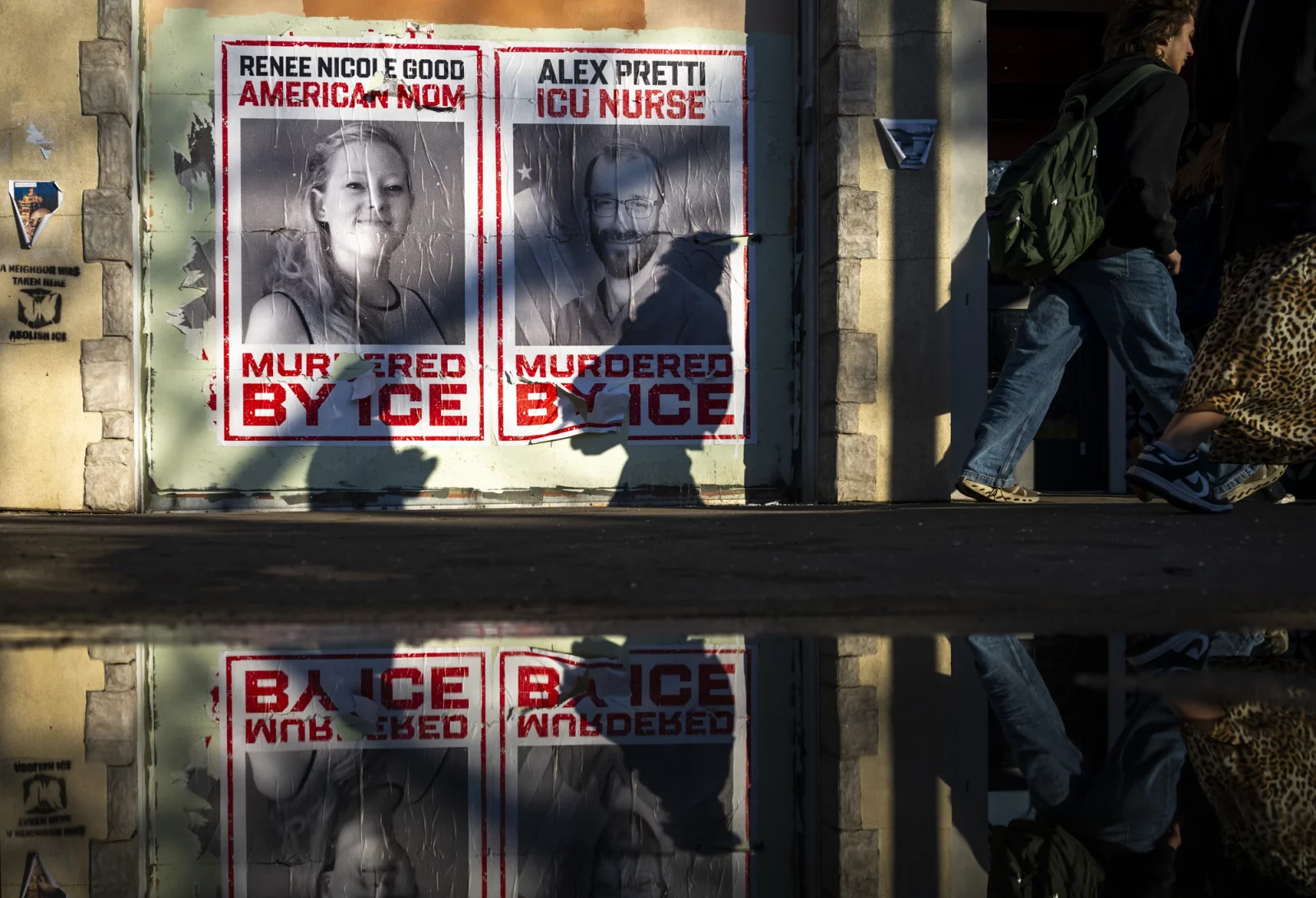
The Justice Department finally shared evidence with Minnesota law enforcement 6 months after the shooting deaths of Renee Good and Alex Pretti.
Todd Blanche sat for his confirmation hearing before the senate judiciary committee and testified that his justice department does not target political enemies.
"I would go out on a limb and say we're pretty confident that they're not investigating these agents for any possible crimes," says Rachel Moran, a professor at the University of St. Thomas School of Law who studies police accountability.
Moran says a federal officer who kills a person would normally be subject to a joint investigation between state law enforcement and the federal government. What's happening instead, she says, is much more unusual.
"They appear to be actively preventing the state from investigating," Moran says…
The Department of Justice is buckling under the weight of immigration cases causing a DOJ lawyer in Minneapolis to ask a judge to hold her in contempt just so she can get some sleep.
Former January 6th prosecutors have drafted a memo advising Congress on how to investigate DHS use of force and the murders of Alex Pretti and Renee Good.
The Trump Administration plans to ramp up its retribution against political foes as the Weaponization Czar Ed Martin is removed for leaking grand jury material.
Tusli Gabbard joins FBI agents on a call with Trump after the FBI seized voting machines and ballots from a Georgia Election Office, and we learn that Gabbard seized voting machines in Puerto Rico last spring while investigating Nicolas Maduro for foreign election interference.
We're joined by our good friend, Dahlia Lithwick, Senior Editor at Slate and host of the Amicus podcast, to cover a wide range of topics, including the courts and their role during this difficult time in American history.
We start with Minnesota and the disturbing actions of ICE that have rattled the nation. From the ICE abduction of 5-year-old Liam Ramos to the murders of Renee Good and Alex Pretti, Dahlia connects the dots between eroding civil liberties and a Supreme Court that has systematically dismantled accountability.
We also discuss Trump's recent FBI seizure of ballots in Georgia and what that could mean for our democracy. Dahlia issues a strong warning about where all of this could be heading and how we need to be prepared for it.
Plus, Dahlia walks us through some of the cases currently before the Supreme Court: the further gutting of the Voting Rights Act, controversial redistricting, Trump's retribution, and tariffs. Interview:
After another horrifying murder and ICE’s continued unwelcome presence in Minnesota, Al is joined by friend of the show, political scientist, and emeritus scholar at the American Enterprise Institute, Norm Ornstein, to discuss what is happening in their home state.
After widespread reports of American citizens being detained, ICE using children as "bait," and the murders of Renee Good and Alex Pretti, the Trump administration seems open to drawing back the ICE presence in Minnesota. Al and Norm discuss what a possible deal could look like to get them out of the state. Will Stephen Miller and Kristi Noem face any consequences for their lies and aggression?
After spending time meeting with organizers in the Twin Cities, Al shares what he learned from constitutional observers and others making their community safer and caring for each other. We also discuss the danger of the federal government getting its hands on state voter rolls. Was Trump's invasion ever about enforcing immigration laws? Or was it more about retribution?
Interview:
In this episode of Straight White American Jesus, Brad Onishi—author of American Caesar: How Theocrats and Tech Lords Are Turning America into a Monarchy—is joined by co-host Dan Miller, Professor of Religion and Social Thought at Landmark College. They begin by unpacking the ongoing ICE operations in Minnesota, framing the federal crackdown as a clash between authoritarian state power and a deeply organized, nonviolent response by ordinary Minnesotans. Drawing on political theory and on-the-ground reporting, Brad and Dan argue that what's unfolding in the Twin Cities is not a partisan skirmish but a vivid example of democracy in action: neighbors mobilizing to protect one another against coercion, violence, and the erosion of basic rights.
The conversation then turns to two deeply troubling developments with national implications. First, they examine the killing of Alex Pretti, an ICU nurse and legal gun owner, and the Trump administration's sudden hostility to Second Amendment arguments—revealing how rights are selectively applied depending on political loyalty. Finally, they analyze the FBI raid on a Georgia election office, tracing its roots to Trump's refusal to accept the 2020 election results and warning of the chilling precedent this sets for future elections. Taken together, these stories reveal a pattern: the criminalization of dissent, the dehumanization of political opponents, and an accelerating effort to use state power to intimidate, suppress, and control. Interview:
The FBI opened a civil rights investigation into the shooting death of Renee Good in Minneapolis but Trump administration officials quickly shut it down.
The Department of Justice Civil Rights Division has pivoted to investigating discrimination against white people
Judge Engelmayer has denied the letter motion filed by Representatives Khanna and Massie to appoint a Special Master over the Epstein Files Transparency Act.
Two whistleblowers have uncovered an internal DHS memo instructing ICE agents to enter homes without a proper warrant.
As tensions escalate in Minnesota and Donald Trump threatens to invoke the Insurrection Act, ICE’s brutality continues. We are joined by the current Lieutenant Governor of Minnesota and candidate for the U.S. Senate, Peggy Flanagan, to discuss the crisis in her and Al's home state.
Flanagan details the cover-up and lies surrounding the Renee Good investigation. The DOJ has withheld evidence and prohibited the state from investigating the case, while lying about how the officer who shot Good has “absolute immunity.” It is clear Trump, Kristi Noem, JD Vance, and the administration have no interest in justice.
Flanagan also shares stories of the vibrant Somali community who have contributed so much to the state, despite the attempts to malign them. She also shares stories of talking to constituents around the state and how she's finding common ground with rural farmers over the cost of healthcare and tariffs. Interview:
Brad and Dan examine the escalating ICE presence in Minneapolis following the fatal shooting of Renee Good, situating the operation within a broader pattern of authoritarian governance under the Trump administration. They unpack how federal immigration enforcement has begun to resemble occupation style tactics, including minimal vetting of ICE agents, sweeping immunity claims for officers, and the use of overwhelming force in civilian spaces. Drawing on historical parallels to fascist regimes and social psychology experiments like the Stanford Prison Experiment, the conversation explores how power, dehumanization, and impunity reinforce one another when federal agencies are weaponized against dissent.
The episode also interrogates the gendered and racial dynamics at play, particularly the demonization of white women protesters framed by right wing media as dangerous or hysterical. Brad and Dan discuss how white femininity functions within white Christian supremacy, why Renee Good's identity as a queer woman posed a threat to patriarchal power, and how Fox News and Christian nationalist figures have celebrated or justified state violence. The conversation widens to include federal overreach beyond immigration, including pressure on the Department of Justice to investigate Federal Reserve Chair Jerome Powell, threats to institutional independence, and the administration's seizure of Venezuelan oil revenue. Throughout, the hosts connect these developments to a coherent ideological project rooted in Christian nationalism, racial hierarchy, and authoritarian control, warning that the expansion of state power rarely stops with its initial targets. Interview:
Former ICE chief of staff Jason Hauser recently wrote in USA Today: "When enforcement is driven by messaging instead of mission, when optics outweigh judgment and when leadership substitutes spectacle for strategy, the risk to officers, civilian and public safety increases exponentially."…
Brad returns from a two week break to examine three disturbing stories that reveal how authoritarian power is expanding in the United States and how empathy is being systematically stripped from public life. He begins with the killing of Renee Nicole Good in Minneapolis, a white American poet and mother shot by an ICE officer during an operation. The administration's response was marked by complete indifference, with officials offering no compassion for Good or her family and JD Vance asserting that the officer should have absolute immunity. Brad argues this case represents a dangerous shift. The logic of impunity long applied to marginalized communities is now being extended outward, signaling that anyone can become a target once state violence is normalized.
The episode then turns to the U.S. operation in Venezuela and Trump's escalating threats toward Greenland. In Venezuela, Trump openly framed the military action around oil interests rather than democracy, reviving a Monroe Doctrine style vision of hemispheric control rooted in Christian and Western supremacist ideology. Threats toward Greenland further signal an imperial mindset that would shatter NATO alliances and dismantle the post World War II international order. Across all three stories, Brad traces a consistent theme. Empathy is treated as an obstacle to power, impunity is expanding, and figures like JD Vance are refining a more polished authoritarian message for the future. The result is a political project that no longer seeks separation or retreat, but expansion, domination, and the erosion of democratic restraint. Interview: