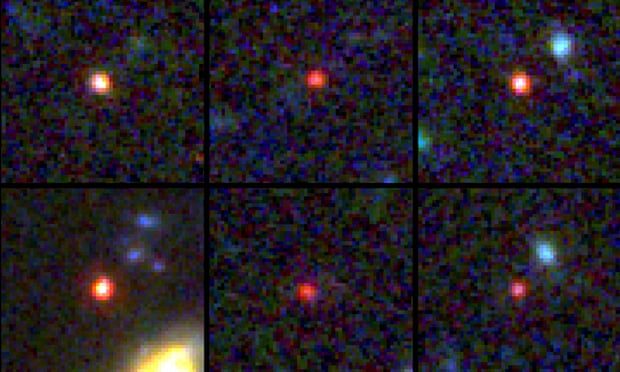
Explaining the existence of such massive galaxies close to the dawn of time would require scientists to revisit either some basic rules of cosmology or the understanding of how the first galaxies were seeded from small clouds of stars and dust...
https://www.theguardian.com/science/2023/feb/22/universe-breakers-james-webb-telescope-detects-six-ancient-galaxies
Showing posts with label galaxies. Show all posts
Thursday, February 23, 2023
Tuesday, May 7, 2019
Wobbling jet stream seen flowing from black hole - CBC News
Researchers think they may have stumbled upon a clue to how new galaxies are formed after observing rapid and unexpected emissions from a massive black hole.....
https://www.cbc.ca/news/canada/edmonton/black-hole-jet-stream-1.5118567
Thursday, March 23, 2017
Saturday, October 15, 2016
Surprise! The Universe Has 10 Times More Galaxies Than Scientists Thought
More than a trillion galaxies are lurking in the depths of space, a new census of galaxies in the observable universe has found — 10 times more galaxies than were previously thought to exist.
An international team of astronomers used deep-space images and other data from the Hubble Space Telescope to create a 3D map of the known universe, which contains about 100 to 200 billion galaxies. In particular, they relied on Hubble's Deep Field images, which revealed the most distant galaxies ever seen with a telescope. ...
http://www.space.com/34382-universe-has-10-times-more-galaxies-hubble-reveals.html
Tuesday, September 6, 2016
Scientists discover a 'dark' Milky Way: Massive galaxy consists almost entirely of dark matter
Using the world's most powerful telescopes, an international team of astronomers has found a massive galaxy that consists almost entirely of dark matter.
The galaxy, Dragonfly 44, is located in the nearby Coma constellation and had been overlooked until last year because of its unusual composition: It is a diffuse "blob" about the size of the Milky Way, but with far fewer stars.
"Very soon after its discovery, we realized this galaxy had to be more than meets the eye. It has so few stars that it would quickly be ripped apart unless something was holding it together," said Yale University astronomer Pieter van Dokkum, lead author of a paper in the Astrophysical Journal Letters....
Wednesday, May 25, 2016
How Dark Matter Shapes Galaxies
Astronomer Katey Alatalo describes how dark matter disrupts stars...
Subscribe to:
Posts (Atom)